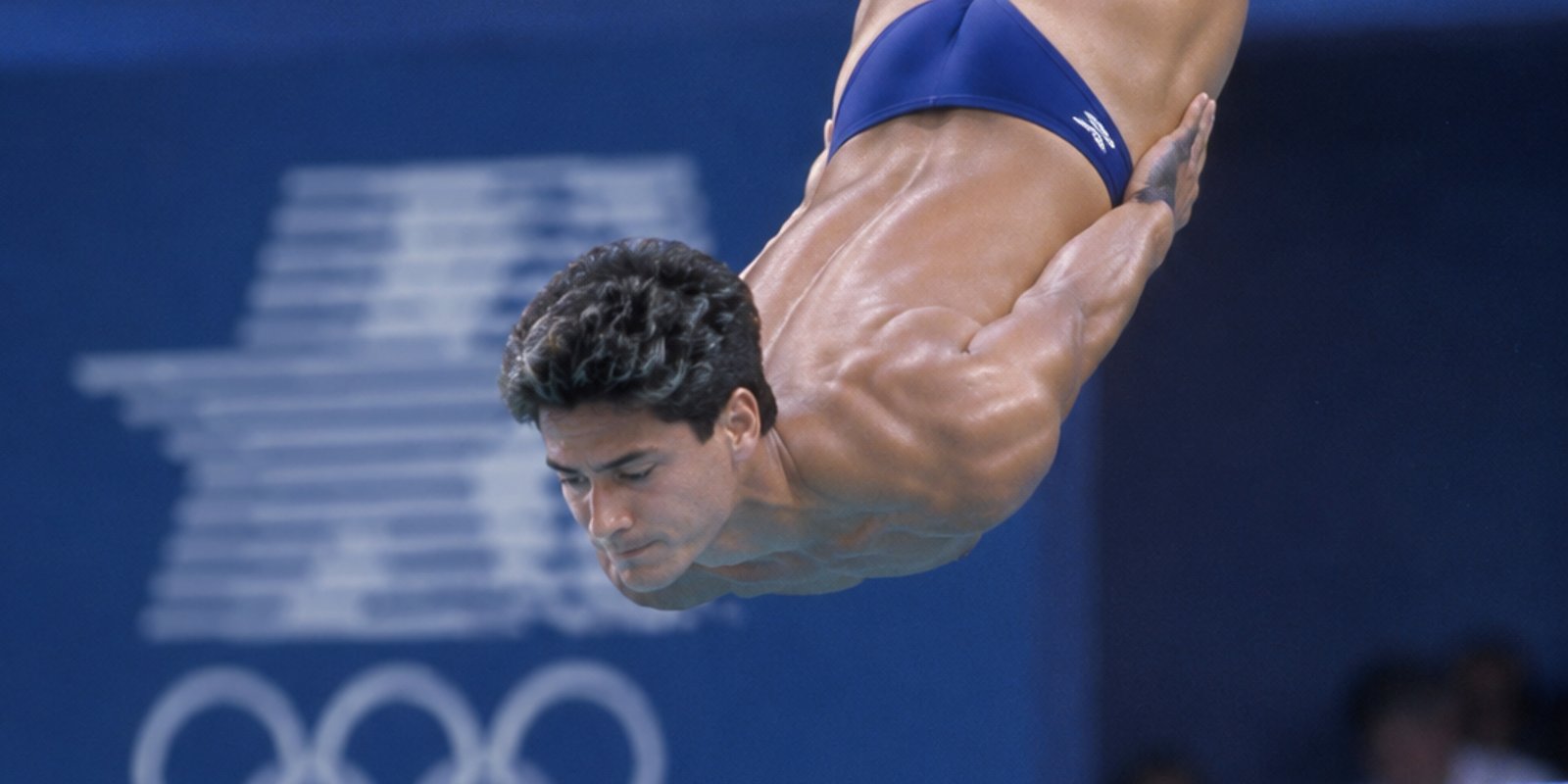
Four things set a Greg Louganis dive apart: where he took off from the board, how steady his body looked in the air, how late he opened out of the tuck and how little water he moved on the way in. Each one has a reason behind it. Several come from his own descriptions and from the people who coached him.
I first watched him on TV during the Seoul Olympics in 1988. It was one of those moments where I thought "damn, I love this guy". It also made me want to dive, so I did for a while, until the costs got too high. What stayed with me from those dives was how late he opened out of the tuck. That is where this post spends the most time.
Take-off: waiting for the board
A springboard is a flexible plank that bends when a diver lands on it and springs back. Most divers set the board's pivot point (the fulcrum) close to the front. Louganis moved it further back. In a 1981 profile, Sports Illustrated reports that he did this because he was willing to wait longer for the board. He said the board would be slower but would "throw the diver up higher".
The timing came from listening. He judged his jump by the sound and motion of the board, leaving as it started to rise again. A slow-motion study in Miami found his feet hit the board about 1/32 of a second before it reached the bottom of its bend.
The payoff is height. That same profile says his feet reached roughly the level of the 7-meter warm-up tower from the 3-meter board. More height means more time to rotate and more time to finish the dive before the water arrives.
Rotation and the late opening
When a diver folds into a tuck (knees pulled to the chest, hands holding the shins) the body spins faster. When the diver straightens out, the spin slows. So the moment of opening is a decision about when to stop adding speed and start preparing for the water.
Louganis opened late. My reading is that this takes nerve, because the longer you stay compact the less time you have to see where the water is. That is the part I find inspiring. It is part of why I started diving at all.
He had an answer for the risk. He described an awareness in the air something like a cat's sense, with his peripheral vision telling him how high he was above the water. He also said that when he dived well he had "all the time in the world to attend to the details."
The clearest test came in Seoul. In the platform final he needed at least 85.57 points on his last dive to win. He chose a reverse 3½ somersault in the tuck position, which carried a degree of difficulty of 3.4 (the number that multiplies the judges' marks) and scored 86.70. His coach Ron O'Brien told Sports Illustrated afterward that he did not know of "a bigger dive done in Olympic history". The gold and the 1.14-point margin behind it are covered in the Seoul section of the Olympics page.
Body control: the lines coach and rivals noticed
A "line" is the shape of the body during a dive: straight legs, pointed toes, a flat back. The same 1981 profile quotes a rival, Mike Finneran, listing good toes, good feet, good legs, a good back position and flexible shoulders. It describes his reverse 1½ somersault in the layout position (body straight) as appearing to hang in the air.
O'Brien put the quality down to grace together with the strength to hold his shape in the air. Sammy Lee, a two-time Olympic champion who coached him as a junior, called him "the only diver I have seen who is capable of getting 10s on all his dives".
He started dance, acrobatics and gymnastics at about 18 months old, which is covered in the early life section of his biography. I have not found a source that links those classes directly to his lines in the water, so that connection is a question rather than a fact.
Muscle memory and mental rehearsal
The diving chapter of his memoir Breaking the Surface is the part I remember best. As I recall it, the chapter is about building muscle memory through repetition until a dive happens without thought, which shows how much precision and skill the sport demands.
His coach worked on the mental side too. According to NBC Sports' obituary for O'Brien, O'Brien helped Louganis visualize dives before performing them and tied new dives to competition goals so he could push through fear. Louganis began training with O'Brien in Mission Viejo, California, in 1978.
Entry: the rip
The entry is the dive's final impression. Sports Illustrated describes a "rip" entry as the goal for a perfect 10: the body perpendicular to the water, arms outstretched with palms out and the toes ideally curled under like a ballerina's. Done well, the diver goes in with very little splash.
Louganis described the end of a dive differently. In Newsweek, he said the crowd noise gave way to silence the moment he entered. He was surrounded by silence. Sports Illustrated said of that final Seoul dive that he pierced the water straight and true.
What set him apart from other elite divers
No source ranks him against other elite divers feature by feature. What the accounts above share is a combination:
- A take-off built on waiting. A fulcrum set back and a jump timed to the board's sound.
- Height that bought time. More air time for the same dive.
- A held shape. Lines that rivals and coaches called out by name.
- A clean finish. The rip entry, even on the hardest dive on his list.
His own explanation was simple. When a dive is going well, there is time for the details.
Sources